- Have any questions?
- info@conceptsandcareers.com


Mastering Disruption: A Strategic Playbook for Thriving in an Era of Constant Change

Angoor AI: The Agentic CRM Reimagining Customer Experience in the Age of AI
April 8, 2026
Helium: The People’s Network That Tried to Decentralize Telecom
April 16, 2026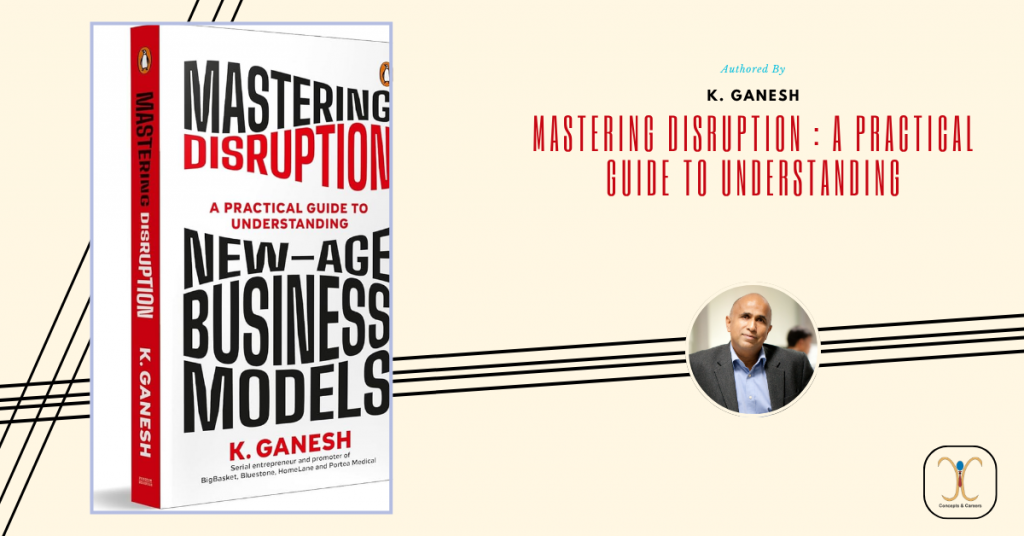
Comprehensive Analysis and Summary of Mastering Disruption: A Practical Guide to Understanding Disruptive Innovation by K. Ganesh
In a world defined by rapid technological evolution, shifting consumer behaviors, and collapsing industry boundaries, disruption is no longer an exception—it is the norm. In Mastering Disruption: A Practical Guide to Understanding Disruptive Innovation, K. Ganesh presents a pragmatic and experience-driven framework for understanding, anticipating, and leveraging disruption.
Unlike purely academic takes on disruption, Ganesh brings an operator’s lens—blending entrepreneurial insights with strategic clarity. The book serves as a guide not only for startups aiming to disrupt industries but also for incumbents striving to survive and evolve.
1. Understanding Disruption: Beyond the Buzzword
Ganesh begins by demystifying the term “disruption,” which is often overused and misunderstood. True disruption is not merely about innovation—it is about changing the rules of the game.
He distinguishes between:
- Incremental Innovation → Improving existing systems
- Disruptive Innovation → Creating new models that redefine markets
Disruption typically occurs when:
- New technologies lower barriers to entry
- Customer expectations shift dramatically
- Business models evolve faster than incumbents can adapt
👉 Key Insight: Disruption is not about being better—it’s about being different in a way that matters.
2. The Anatomy of Disruption
Ganesh outlines the core components that drive disruption:
1. Technology Enablers
Advancements such as AI, cloud computing, and mobile connectivity act as catalysts.
2. Business Model Innovation
Companies disrupt not just through products, but through:
- Pricing models
- Distribution strategies
- Customer engagement
3. Customer-Centricity
Disruptors win by solving unmet or underserved needs.
4. Speed and Agility
Startups outperform incumbents because they:
- Move faster
- Experiment more
- Adapt quickly
3. Why Disruption Happens: Structural Shifts
Ganesh emphasizes that disruption is driven by structural changes, not isolated events.
Key Drivers:
- Digital Transformation → Everything becomes data-driven
- Globalization → Markets become interconnected
- Democratization of Technology → Tools become accessible
- Changing Consumer Behavior → Demand for convenience and personalization
For modern businesses, especially those operating in AI and digital ecosystems, these drivers are foundational.
4. The Innovator’s Dilemma in Practice
Building on ideas similar to those in The Innovator’s Dilemma, Ganesh explains why established companies struggle to respond to disruption:
Key Reasons:
- Focus on existing customers
- Fear of cannibalizing revenue
- Bureaucratic inertia
- Short-term performance pressures
This creates a paradox:
👉 The very strengths that make companies successful also make them vulnerable.
5. The Disruptor’s Playbook
Ganesh provides a clear roadmap for startups and innovators:
Step 1: Identify Market Inefficiencies
Look for:
- High costs
- Poor user experience
- Lack of accessibility
Step 2: Build a Differentiated Model
Focus on:
- Simplicity
- Scalability
- Affordability
Step 3: Target Underserved Segments
Disruptors often begin at the bottom or edges of markets.
Step 4: Scale Rapidly
Leverage technology and networks to grow quickly.
6. Business Model Innovation: The Real Game Changer
One of the strongest themes in the book is that disruption is often less about technology and more about business model innovation.
Examples of shifts include:
- Ownership → Access (subscription models)
- Offline → Digital-first
- Product → Platform
This is particularly relevant in:
- SaaS ecosystems
- AI-driven platforms
- Marketplace models
👉 Strategic Insight: If you’re only innovating your product, you’re already behind.
7. The Role of Data and Technology
Ganesh highlights how data is becoming the backbone of modern disruption.
Key implications:
- Data enables personalization
- AI enables automation
- Analytics enables better decision-making
For companies, this means:
👉 Competitive advantage = Data + Speed + Execution
8. Incumbent Strategy: How to Survive Disruption
Ganesh doesn’t just focus on startups—he also provides guidance for established companies.
Key Strategies:
- Adopt a Dual Approach
- Optimize existing business
- Experiment with new models
- Create Independent Innovation Units
- Avoid internal resistance
- Invest in Technology
- Build digital capabilities
- Embrace a Learning Culture
- Encourage experimentation
9. The Human Element: Leadership in Disruptive Times
Disruption is not just technological—it is cultural.
Ganesh emphasizes:
- Leadership mindset
- Organizational agility
- Talent adaptability
Leaders must:
- Embrace uncertainty
- Encourage innovation
- Make bold decisions
👉 The biggest risk today is not failure—it is irrelevance.
10. Applications in Today’s Business Landscape
Ganesh’s framework is highly relevant across industries:
Startups:
- Identify niche inefficiencies
- Build scalable digital solutions
Enterprises:
- Rethink legacy systems
- Invest in innovation ecosystems
AI & Tech Companies:
- Focus on user-centric applications
- Optimize micro-experiences
Entrepreneurs (like your ecosystem):
- Spot value gaps
- Build modular, scalable ventures
- Leverage cross-industry insights
11. Critique and Perspective
While the book is practical and insightful:
- It may simplify complex disruptions
- Execution challenges are understated
- Not all industries are equally disruptable
However, as a strategic guide, it is highly actionable.
Conclusion: Disruption is a Choice, Not a Threat
Mastering Disruption by K. Ganesh reframes disruption from a threat into an opportunity.
The key takeaway:
👉 You can either be disrupted—or become the disruptor.
In a world driven by:
- AI
- Digital ecosystems
- Rapid innovation cycles
Success will belong to those who:
- Think differently
- Move quickly
- Adapt continuously
Disruption is not coming.
It is already here.