- Have any questions?
- [email protected]


OpenCFO — Building the AI-Native Financial Execution Layer for Global Finance Teams

Navigating the Inner Landscape: A Deep Dive into “Confessions of a Pilgrim” by Paulo Coelho
March 9, 2026
Unveiling Mysteries: Exploring “The Witch of Portobello” by Paulo Coelho
March 16, 2026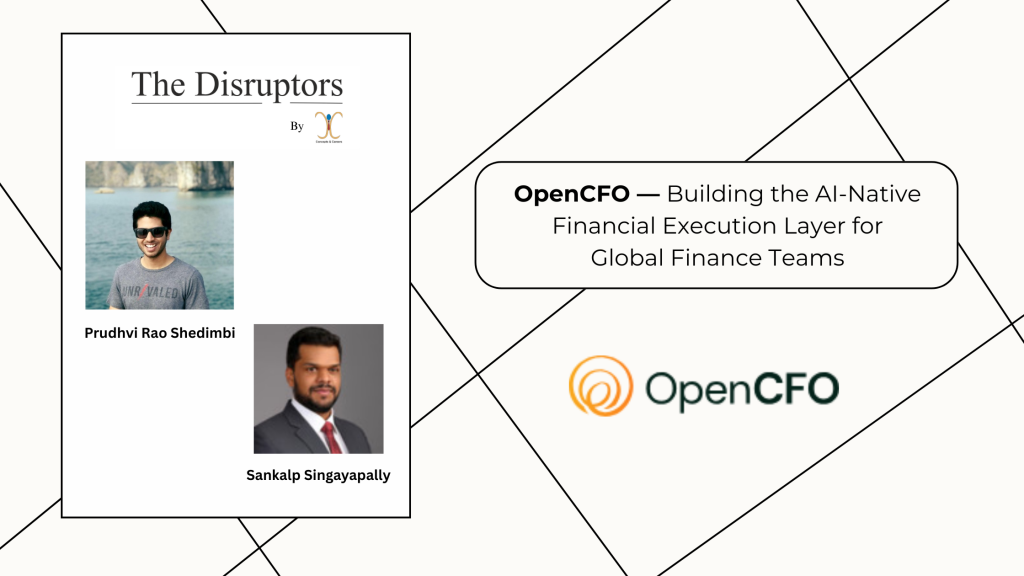
The Rise of the AI-Native CFO Stack
Finance teams are often the backbone of modern businesses, yet their operational systems remain fragmented and manual. Accounts payable, treasury management, vendor payments, reconciliation, and reporting often live across multiple tools and spreadsheets.
OpenCFO, a fintech startup founded in 2025 by Prudhvi Rao Shedimbi and Sankalp Singayapally, is tackling this fragmentation by building an AI-native financial execution platform designed for globally distributed mid-market companies.
Rather than creating yet another finance dashboard, OpenCFO aims to build what its founders call the “execution layer for the CFO office” — a unified platform where AI agents automate the financial workflows that companies traditionally manage manually.
In a world where businesses operate across multiple currencies, payment rails, and regulatory environments, such automation is becoming essential.
The Problem — Fragmented Finance Operations
Mid-market companies expanding across borders face a complex set of financial challenges:
- Multiple bank accounts and payment systems
- Separate tools for accounts payable and receivable
- Manual reconciliation between systems
- Delays in cross-border payments
- Limited real-time visibility into liquidity
CFOs often spend significant time stitching together ERP tools, bank portals and spreadsheets just to maintain operational accuracy.
This fragmentation slows decision-making and increases operational risk.
OpenCFO’s founders believe the problem is not just inefficiency — it’s the lack of a unified operating system for finance teams.
The Solution — An AI-Native Financial Operations Platform
OpenCFO provides a subscription-based SaaS platform that unifies key financial workflows into a single AI-driven system.
The platform integrates with:
- Enterprise Resource Planning (ERP) systems
- Banking platforms
- Global payment rails
- Accounting software
Once connected, AI agents automate and coordinate financial workflows across multiple functions.
Core Capabilities
1. Accounts Payable Automation
The platform processes invoices, schedules payments, and manages vendor workflows automatically.
This reduces manual invoice handling and improves operational efficiency for finance teams.
2. Accounts Receivable & Collections
OpenCFO automates receivable tracking and collections processes, ensuring finance teams maintain visibility into cash inflows and payment cycles.
3. Treasury Management
The system provides real-time liquidity visibility across currencies, entities, and accounts, enabling better treasury decisions.
For companies operating globally, this capability can significantly reduce FX inefficiencies and capital misallocation.
4. Cross-Border Payment Optimization
OpenCFO integrates global payment infrastructure, enabling faster transfers and reducing unnecessary fees typically associated with cross-border transactions.
5. Agentic AI Workflow Automation
The defining innovation is OpenCFO’s agent-based architecture.
Instead of automating isolated tasks, AI agents coordinate across financial workflows. For example:
- An invoice payment automatically updates treasury forecasts
- Payment settlements trigger reconciliation workflows
- Cash-flow changes update financial projections
This interconnected automation enables finance teams to operate with real-time intelligence rather than static reports.
Technology — The Finance Execution Layer
OpenCFO’s architecture combines several modern technologies:
- AI-driven automation agents
- API integrations with ERP and banking systems
- multi-currency treasury infrastructure
- workflow orchestration engines
- real-time financial visibility dashboards
This stack transforms finance operations from fragmented processes into a unified system of execution.
Founders & Leadership
OpenCFO was founded by:
Prudhvi Rao Shedimbi (CEO)
An engineering leader with experience across enterprise infrastructure and distributed systems.
Sankalp Singayapally (COO)
A finance and technology operator with experience in global financial services and investment systems.
The founders identified a common pattern while working with growing companies: finance teams were increasingly responsible for strategic decisions but lacked modern infrastructure to operate efficiently.
Their mission is to build a platform where finance teams move from operational firefighting to strategic control.
Funding & Growth
OpenCFO recently raised $2 million in its first institutional funding round, led by Endiya Partners with participation from angel investors across the United States and India.
The capital will be used to:
- Expand engineering teams in India and the US
- Enhance AI automation capabilities
- Build treasury infrastructure
- Expand customer acquisition across cross-border markets including the US, EU and UK.
Market Opportunity
The market for enterprise financial automation is expanding rapidly.
According to industry reports, enterprise AI automation markets are projected to grow from about $11 billion to more than $70 billion by 2030 as companies increasingly automate operational workflows.
For mid-market companies operating internationally, finance automation remains a major opportunity.
OpenCFO positions itself at the intersection of:
- fintech infrastructure
- enterprise AI automation
- cross-border financial operations
Multi-Role Perspectives
Journalist Lens
OpenCFO highlights a new category in fintech — AI-native financial execution platforms designed specifically for modern, distributed businesses.
Product Lens
By combining multiple finance workflows into a single orchestration layer, OpenCFO reduces operational complexity and increases financial visibility.
Investor Lens
The company targets a high-value niche: globally scaling mid-market companies that require advanced finance infrastructure but cannot afford enterprise treasury platforms.
Operator Lens
For CFOs, OpenCFO offers something increasingly valuable: time and clarity — the ability to focus on strategic planning rather than operational firefighting.
Why OpenCFO Is a Disruptor
OpenCFO disrupts traditional finance infrastructure by shifting from:
Manual processes → AI-driven workflows
Fragmented tools → Unified finance OS
Static reports → Real-time financial intelligence
Instead of acting as a reporting dashboard, the platform functions as the execution engine for the CFO office.
The Bottom Line
OpenCFO represents the next generation of enterprise fintech infrastructure.
By automating payables, receivables, treasury management and cross-border payments within a single AI-native system, the startup is redefining how finance teams operate in a globally connected economy.
As businesses become increasingly distributed and digital, platforms like OpenCFO may become the default financial operating systems for modern companies.