- Have any questions?
- [email protected]


Fermi AI: Guiding Deeper Learning with Intelligent AI Tutors

Exploring the Depths of Existence: A Comprehensive Analysis of “Hamlet” by William Shakespeare
January 28, 2026
The Enigmatic Adventures of Sherlock Holmes: A Comprehensive Analysis of Arthur Conan Doyle’s Masterpiece
January 28, 2026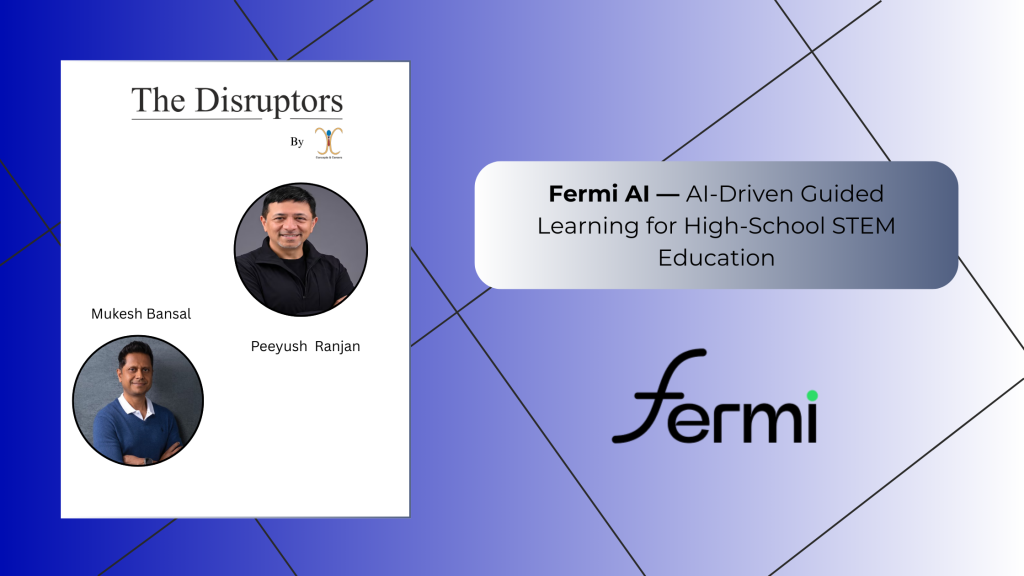
In early 2026, edtech took a meaningful leap forward with the launch of Fermi AI (Fermi.ai) — an AI-first education platform designed to transform how students learn STEM (Science, Technology, Engineering and Mathematics) subjects at the high-school level. Founded and publicly announced by Peeyush Ranjan, a former CTO of Flipkart and veteran executive at Google and Airbnb, Fermi AI enters the market with a clear mission: use artificial intelligence to deepen learning, not just answer questions quickly.
Headquartered in Singapore and operating in both India and the United States, Fermi AI builds on the belief that the future of education isn’t about shortcuts or answer delivery — it’s about strengthening conceptual understanding and problem-solving capabilities.
Why Fermi AI Is a True Disruptor
Traditional AI learning tools tend to prioritize speed: the fastest route to an answer. Fermi AI disrupts this formula by balancing speed with learning quality. Instead of simply providing solutions, its tutoring engine guides students through reasoning and understanding, supporting what educators call “productive struggle” — the cognitive effort learners expend while working through challenging problems.
At its core, Fermi AI is built around four key pedagogical pillars:
- Adaptive Real-Time Tutoring – The AI doesn’t just answer questions; it diagnoses where a student’s reasoning breaks down and offers step-by-step guidance to strengthen understanding.
- Handwriting-First Canvas – Students can use digital ink and stylus tools to write equations and draw diagrams, making the learning experience closer to traditional pen-and-paper study.
- Curriculum-Linked Concept Graphs – The platform maps topics to established curricula (including AP, IB and national boards), ensuring content aligns with exam requirements and learning sequences.
- Diagnostic Insights for Teachers – Educators receive visibility into student progress and knowledge gaps, enabling targeted support where it matters most.
This approach positions Fermi AI not as a homework answer machine, but as a thinking partner that keeps students engaged with material and strengthens long-term retention — a fundamental shift from many existing AI tutors.
The Product in Action (Product Lens)
Fermi AI currently focuses on mathematics, physics, and chemistry, providing tools designed for high-school learners around the world. Pilots conducted in India and the US showed encouraging mastery improvements, particularly as students engaged with the platform’s interactive canvas and adaptive guidance models.
Key features include:
- Handwriting and diagram capabilities that mirror the natural learning had with teachers.
- Step-by-step reasoning support that prevents shortcut thinking and reinforces conceptual clarity.
- Curriculum alignment and diagnostics that help teachers and tutors understand where learners struggle.
These product features aim to mitigate the risk of superficial learning — a common critique of many today’s AI learning tools — by keeping students actively thinking and solving, rather than passively copying answers.
Founders & Vision (Leader Lens)
Fermi AI is led by Peeyush Ranjan, a technologist with deep experience in building scalable technology organisations. Before launching Fermi AI, Ranjan held leadership roles at Flipkart, Google and Airbnb — bringing not only AI expertise but also strong operational experience to edtech.
The startup was incubated at Meraki Labs, an early-stage venture studio and fund co-founded by Mukesh Bansal (co-founder of Myntra and Cult.fit), which provides strategic and operational support to the initiative.
Together, the founders are building an edtech platform that trades short-term correctness for long-term mastery, helping learners develop deep skills that matter for academic performance and future STEM careers.
Market Opportunity & Why It Matters (Analyst Lens)
Despite historical fluctuations in edtech funding, the market for AI-powered learning tools remains significant — especially for solutions integrated with classroom frameworks and examinations. Fermi AI’s pedagogical approach addresses a major gap: while many AI tutors focus on speed and surface correctness, few prioritize reasoning growth and conceptual understanding.
This positions Fermi AI at the intersection of adaptive learning, AI pedagogy and curriculum support, a space poised for growth as educators and learners demand smarter tools that blend technology with effective educational practice.
Risks & Challenges (Risk Lens)
- Balancing support with independence: Fermi AI must carefully calibrate guidance to avoid becoming an answer generator — preserving productive struggle while keeping learners motivated.
- Curriculum diversity: Global learners follow diverse syllabi; scaling requires broad curriculum mapping and localisation.
- Adoption in traditional systems: Classroom integration remains a challenge for all edtech tools; user and teacher acceptance will shape product success.
The Bottom Line
Fermi AI is a fresh entrant in the AI edtech space, bringing reasoning-first pedagogy, adaptive tutoring and real-time insights to high-school STEM education. Guided by tech leadership with deep operational experience, the startup focuses on strengthening conceptual learning rather than just delivering answers — a fundamental shift in how AI can support education globally.
If Fermi continues to iterate with real teachers and students at its core, it could become a standout model for the next generation of intelligent learning platforms.